
%402x.svg)
If you run a private international school, you already know the market is growing. What you may be feeling more acutely is that your share of it isn't growing as quickly as it should.
The global K12 international schools market generates over $64 billion in annual tuition fees and is projected to nearly double in size by 2034. Student enrollment has risen by 13% over the past five years, while the number of international schools has grown by 10% over the same period. That is real expansion. But market expansion does not automatically translate into growth at your school. And for many school owners, there is a widening gap between what the market wants and what their current model can deliver.
That gap is where enrollment stalls, retention softens, and the justification for tuition becomes harder every year.
The curriculum arms race is already underway, and most schools are losing.
Here is what the data shows: families are actually choosing schools for curriculum credentials. According to ISC Research, the curriculum a school offers is a major factor in parents' school choice, as families see it as the direct pathway to further education. They are not choosing based solely on campus aesthetics or teacher quality. They are choosing based on whether your school can get their child into the university and the country they want, with the credentials that travel.
And the bar keeps rising. Seventy-eight percent of international schools now offer more than one curriculum, not because it is easy or cheap, but because single-curriculum schools are increasingly failing families who want optionality. Between 2020 and 2024, the number of IB programmes offered worldwide grew by 34%. Your competitors are not standing still.
As a school owner, this creates a real operational problem. You can see the demand. You know what families are asking for. But hiring specialist teachers for advanced coursework, building out accredited pathways, and adding electives that your current staff cannot cover, that is not a marketing problem. That is a structural one.
The gap between what families want and what you can build fast enough is widening.
Consider what a well-informed family shopping for a private international school in 2025 is actually comparing across schools. They want IB or AP options. They want a university counseling service that understands admissions in multiple countries. They want flexibility for a child who is a competitive athlete, or who learns at a different pace, or whose goals shift in grade 10. They want English fluency pathways that are genuinely rigorous. And they want to know that if their child's ambitions grow, your school can grow with them.
Around 55% of parents now prefer schools that integrate globally recognized diplomas, not as a differentiator, but as a baseline expectation. If you cannot credibly make that claim, you are not losing to a better-marketed school. You are losing to a better-structured one.
Building that structure internally is the most expensive, slowest path available to you. Over 45% of international schools already report significant difficulty hiring qualified teachers with global teaching experience, and that constraint is not easing. Curriculum development, specialist hiring, accreditation systems, platform infrastructure, scheduling redesign, even well-resourced schools find that building a full international academic ecosystem from scratch takes years they do not have and capital they would rather deploy elsewhere.
This is exactly where the next phase of competition will become even more visible, not only in what schools offer, but in how families make decisions.
Much of the recent excitement in AI has been about tools: systems that do more than generate text and can now search, organize, analyze, automate, and act. In education, the most relevant version of this is not agentic commerce, but agentic education: the idea that intelligent systems will increasingly help students, parents, teachers, and schools make better academic decisions.
Like many things in AI, agentic education is sometimes overhyped too early. People imagine fully autonomous systems that can educate a child from beginning to end without human guidance. That vision may be far off, and in many cases, it is neither realistic nor desirable. It is more useful to think of agentic education as developing in stages. And for school owners, these stages offer a very practical glimpse into how the parent and student decision journey will evolve.
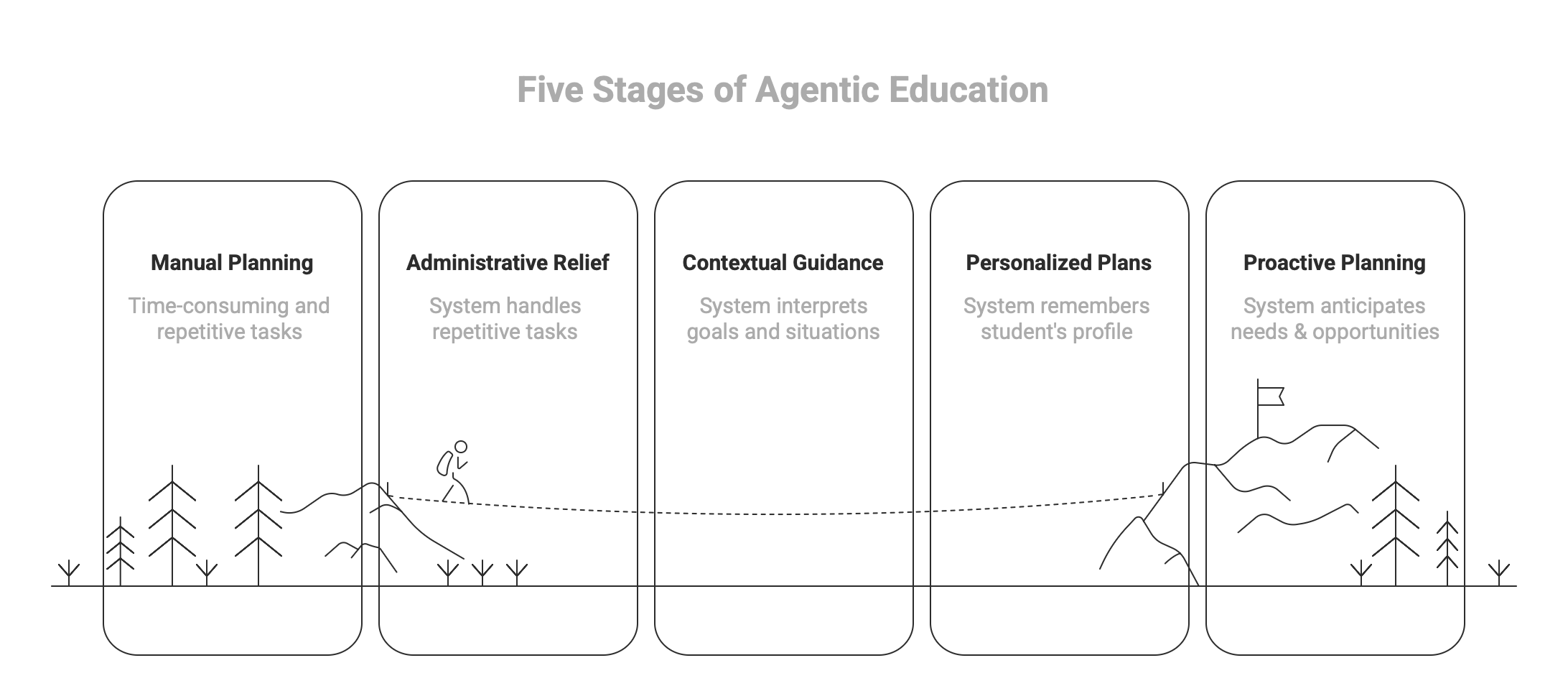
At the first level, the family still makes all the important decisions. The system removes repetitive tasks. Instead of filling out long forms, re-entering the same details, searching for schedules, or navigating multiple platforms, families can rely on an assistant to handle enrollment steps, gather documents, organize assignments, surface deadlines, and simplify communication. The system is not deciding anything. It is simply reducing administrative burden. In education, this alone creates major value because friction at the beginning of the journey often shapes the entire perception of the institution.
At the second level, families stop searching for rigid keywords and start describing goals and situations. A parent no longer searches by course title alone. Instead, they might say: my daughter is entering 10th grade, is strong in math, wants to study engineering abroad, needs to improve academic English, and may want AP or dual credit options. The system then interprets the context and surfaces relevant pathways, course options, readiness indicators, support tools, and timeline recommendations. Instead of forcing families to decode a catalog, the institution begins translating educational complexity into actionable guidance. This makes specialized and long tail educational pathways much easier to discover. It replaces static program listings with contextual guidance.
At the third level, the family stops reintroducing itself every time. The system remembers the student's goals, interests, strengths, constraints, previous courses, budget considerations, assessment results, and advising history. It understands that this student has already completed Algebra II, that the parent is interested in U.S. university pathways, that the family prefers a moderate budget, and that the student may need extra support in writing. The family is still making decisions, but they are doing so from a set of recommendations already shaped around their reality. This dramatically improves the advising experience because the system becomes cumulative rather than repetitive.
At the fourth level, the user delegates more of the planning process. A parent or student might say: build the best academic plan for the next two years that keeps university options open, strengthens English, and stays within our budget. Now the system does more than retrieve information. It compares options, weighs trade-offs, maps sequences, recommends a pacing plan, flags risks, and builds a proposed pathway. Human counselors, teachers, and parents still review and guide the final decision, but the heavy lifting of structuring the plan has already been done. This is the stage most people mean when they talk about AI transforming education. The system is not replacing educators. It serves as a high-capacity planning partner, saving time and increasing precision.
At the fifth level, there is no prompt. The system already understands the student's calendar, academic goals, current performance, application timeline, and developmental needs. Before the family even asks, it surfaces what matters next: a reminder that AP readiness should be assessed now, a suggestion to begin college essays in summer, a warning that course pacing indicates a risk of overload, or a recommendation to add a prerequisite before pursuing a more advanced subject. In its most advanced form, the system helps ensure that the right support, the right opportunity, and the right intervention arrive before they are urgently needed.
This is the most forward-looking vision of agentic education: a model in which students are not left to discover critical academic steps too late, but are guided proactively through a system that is responsive, contextual, and intelligent.
Why does this matter to a school owner now? Because this is where the next enrollment advantage will come from. Families are no longer comparing only the curriculum. Increasingly, they will compare decision quality. They will compare which school helps them understand the best path more quickly, with greater clarity, less friction, and better personalization.
Today, most of education is hovering between levels 1 and 2. Many schools are still focused on digitizing paperwork rather than reimagining decision-making. But the shift has begun.
We are in a moment that feels similar to the early internet era, when the foundations of today’s digital world were being defined. Back then, no one knew which platforms, protocols, or systems would become standard. In the same way, we are now in the early infrastructure phase of AI-enabled education. The tools are emerging, but the long-term winners will be those that build systems with interoperability, trust, and educational usefulness at the center.
The future success of agentic education depends on schools, platforms, counselors, curriculum providers, and technology systems working together. If these systems remain fragmented, the promise will remain limited. But if they become interoperable, if assessments, advising tools, student records, course planning systems, and communication layers can work in sync, education can become dramatically more personalized, proactive, and effective.
There is no certainty about exactly where agentic education will be by the end of 2026 or beyond. But it is already clear that we have moved beyond pure hype and into a real phase of building, experimentation, and practical application.
If this transition is handled well, education will not become less human. It will become more human-centered. Because the ultimate goal is not to automate students. It is to build systems intelligent enough to support each student more personally, more efficiently, and more effectively than ever before.
And that brings us back to the structural decision facing schools today. What your school actually needs to capture this momentum, structurally and operationally
This is where many school owners underestimate the scope of the shift. Partnering with an international online school provider is not simply a content decision. It is an organizational one. To make it work and be genuinely valuable to families, your school needs to build or strengthen a specific set of internal capabilities alongside it.
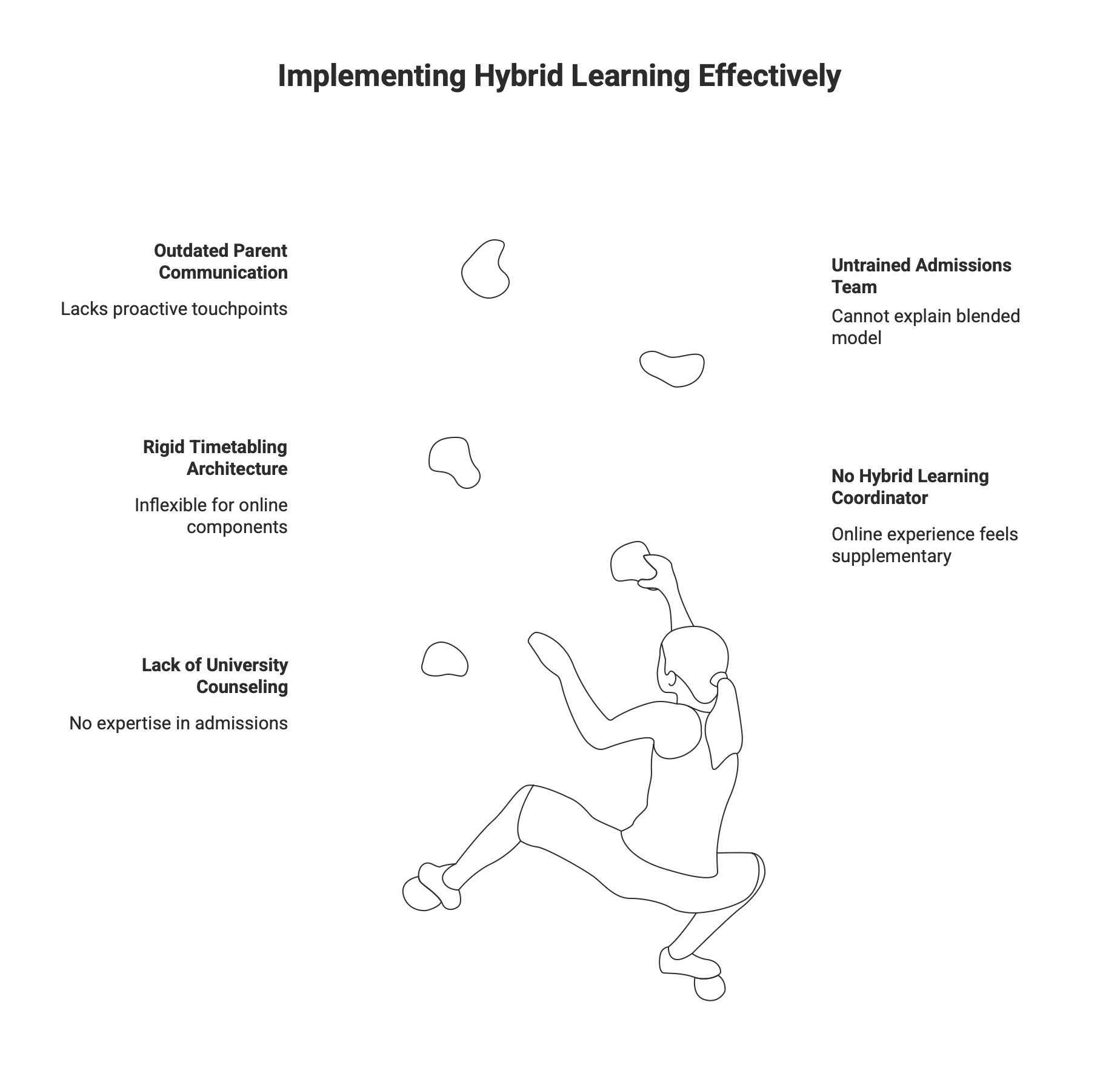
The first and most consequential is university and academic counseling. An ever-growing demand among international school parents is securing university admissions for their students, and that demand requires dedicated expertise, not a homeroom teacher wearing a counseling hat. Schools that are serious about this space are increasingly hiring or designating a full-time university counselor who understands admissions processes across multiple countries and can credibly advise families on how an online or blended academic pathway affects an application profile. If your school does not have this person yet, acquiring an online partner without them means you will offer more courses but deliver less value, because families will not know how to use what you are giving them.
The second structural need is a dedicated hybrid learning coordinator. This role manages the timetable integration, communicates with students and parents, and ensures the online experience feels seamless rather than supplementary. This role does not need to be a full-time hire from day one. In smaller schools, it is often a senior teacher or academic dean who takes on coordination responsibilities as part of a broadened remit. But the role must exist. Without it, online partnerships tend to drift, adopted in name, underused in practice, and invisible in your admissions pitch because no one owns the narrative.
Third, your timetabling and scheduling architecture needs to be flexible enough to accommodate what you are offering. Many private international schools operate on rigid, period-based timetables designed for full in-person delivery. Incorporating online coursework, especially asynchronous or cross-time-zone components, requires either building scheduling flexibility into the school day from the outset or designating protected windows for students to engage with their online provider without conflict.
Fourth, your admissions team needs to be trained to sell the expanded offer. A school can have an excellent partnership in place and still fail to convert inquiries if the person leading the tour or call cannot clearly explain how the blended model works, what credentials it produces, and why it is better than choosing a school that offers only one or the other. Admissions staff need talking points, examples, and confidence in the product. That comes from internal training, not assumption.
Finally, the parent communication infrastructure needs to be upgraded to match the complexity of what you are now delivering. Families choosing a hybrid academic pathway are making a more involved decision than families choosing a standard local curriculum. They need proactive touchpoints, onboarding sessions, regular progress updates, and a clear point of contact for questions. Schools that build this infrastructure retain families. Schools that do not find themselves fielding complaints, managing churn, and losing the word-of-mouth referrals that drive enrollment more than any campaign.
What the smarter structural move looks like
The schools pulling ahead have made a clear decision: instead of trying to build everything internally, they have partnered with international online school providers to extend what they can offer, without extending every department at the same rate. A hybrid learning partnership can be the key to stabilizing, expanding, and future-proofing your international school, but only if the internal scaffolding is in place to make it operational.
A strong online school partner gives your institution immediate access to the courses families are asking for: recognized international credentials, advanced and specialized elective coursework you cannot easily staff locally, and the flexibility to serve students your current timetable cannot accommodate, the high achiever who needs acceleration, the student managing a training schedule, the family seeking dual diploma options for university mobility. You serve them all without hiring six new teachers or overhauling your entire schedule.
More importantly, it changes the conversation you have with prospective families. Instead of explaining what you are building toward, you can show them what exists today. And increasingly, you can show them how intelligently and personally your school can help them navigate it.
What does this mean for you as a school owner? The question worth sitting with is this: when a family asks your admissions team, how far can this school take my child, what is the honest, specific answer?
If that answer depends heavily on what you hope to offer in two or three years, you are already at a disadvantage against schools that have formalized their academic breadth now. Families do not wait. They compare, they decide, and they enroll, often within a single academic year's consideration window.
The market is large, growing, and full of families actively seeking schools that can deliver on global academic ambitions. Parents are demanding that children achieve qualifications recognized both locally and internationally, and schools that cannot meet that demand are increasingly finding it difficult to justify premium tuition levels.
Partnership with an international online school provider is not a workaround. It is a structural decision about what kind of school you want to be and how quickly you want to get there. The on-campus experience you have built remains the core. The partnership adds the academic reach, the credentials, and the flexibility that turn your school from a good local option into a genuinely compelling global one. And over the next few years, the schools that win will not simply be the ones that add more courses. They will be the ones who build the most intelligent, coordinated, and human-centered systems around the family decision journey.
Because the owners investing in that readiness now, the right roles, the right structure, the right internal processes, and the right decision support infrastructure, are the ones who will look back in five years and see it as the decision that changed their trajectory.
The market is there. The families are ready. The only question is whether your school is built to capture them.
References
Caffrey, M. (2024, March 14). International private schools are growing, and diversifying their curriculum offerings. EdWeek Market Brief.
Council of British International Schools. (2018). COBIS teacher supply report.
ICEF Monitor. (2026, February 25). Continuing expansion of K-12 international school sector driven more by growing local demand.
International Baccalaureate. (n.d.). Facts and figures.
ISC Research. (2023, March 23). Recruitment challenges hit international schools.
ISC Research. (2024, February 6). Data on the international schools market in 2024.
Relocate Global. (2025, May 28). Mapping the future: ISC Research’s visual analysis of international school growth.
Harris Kalofonos


%401x.svg)