
%402x.svg)
Global labor markets have entered a phase of permanent volatility. According to the World Economic Forum, 44% of core workplace skills will change by 2027, and more than 60% of workers will require major reskilling within the same window (World Economic Forum, 2023). At the same time, financial vulnerability has reached systemic scale. The OECD reports that across advanced economies, only 38–42% of adults demonstrate minimum financial literacy, with younger cohorts performing even worse (OECD, 2022). The economic cost is no longer abstract. McKinsey estimates that companies lose between 20% and 30% of productivity annually due to skill mismatches, disengagement, and poor decision-making systems (McKinsey Global Institute, 2021). Deloitte further shows that organizations with low human-capability alignment experience 2.4× higher failure rates in transformation initiatives (Deloitte, 2022). At the intersection of these trends—skills disruption, financial instability, and organizational underperformance—a new question now defines education systems, universities, enterprises, and governments:
How do we measure the skills that actually drive performance in the 21st century—and how do we turn that measurement into daily behavioral change?
This is the structural problem that goodvoice.app was built to solve.
The Global Measurement Crisis: Why Most Skills Data Is Behaviorally Invalid
For decades, institutions have relied on self-report inventories, personality questionnaires, and one-off psychometric assessments to measure capability. Behavioral science has long demonstrated that these instruments suffer from systematic distortion. Individuals consistently overestimate socially desirable traits and underestimate their exposure to emotional and cognitive biases (Kahneman, 2011; Dunning, 2011). This produces three cascading failures.
First, these tools measure perceived identity, not behavior under complexity. However, performance in modern systems is driven not by belief but by how individuals respond to uncertainty, pressure, and ambiguity (Weick & Sutcliffe, 2015).
Second, measurement is typically episodic rather than continuous. However, longitudinal research shows that adaptive capacity, emotional regulation, and financial behavior only stabilize through repeated behavioral loops over time(Baumeister & Tierney, 2011; Duckworth, 2016).
Third, the feedback loop between measurement and habit formation is broken. Even when people receive results, most systems do not alter daily cognition, decision framing, or emotional response patterns. This is why most workplace learning initiatives fail to transfer into performance (Salas et al., 2012).
The same failure dominates financial literacy. Lusardi and Mitchell’s foundational work shows that people may understand financial concepts cognitively yet behave irrationally under real risk due to emotional and social distortion (Lusardi & Mitchell, 2014). Knowledge alone does not regulate behavior.
Late high school and the final years of university represent the single most leveraged window for human capability calibration. Neuroscience shows that the prefrontal cortex—responsible for impulse control, planning, reasoning, and risk evaluation—continues to mature into the mid-twenties (Steinberg, 2014). Simultaneously, individuals experience:
- First exposure to financial independence
- High-stakes social identity formation
- Professional role internalization
- Decision-making under uncertainty
- Long-range future planning
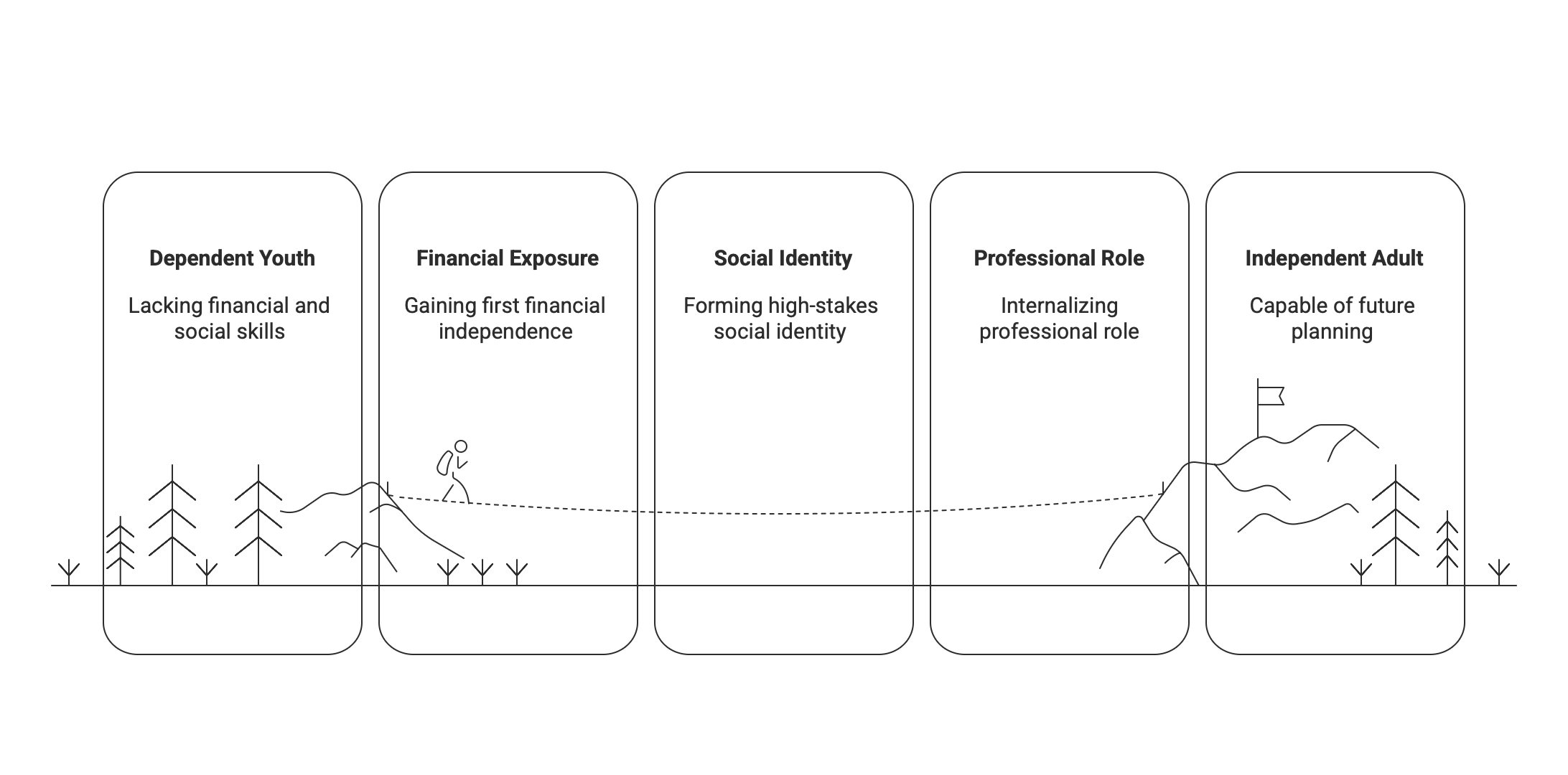
However, paradoxically, skills measurement almost entirely disappears at this stage. Academic grading systems continue to assess content mastery, while the actual predictors of adult success—critical thinking, emotional regulation, communication under pressure, and financial judgment—remain invisible.
This creates institutional blindness. When universities cannot measure behavioral skills, curricula remain content-driven. When companies cannot detect early capability profiles, onboarding defaults to standardized training pathways. Harvard Business School research shows that misaligned early-career onboarding leads to 50–60% higher early attrition and 30% lower long-term performance trajectories (HBR, 2019).
Goodvoice reframes this lifecycle by introducing continuous, pre-professional measurement of real-world capability, enabling both educational institutions and employers to design precision-based curricula and onboarding models rather than relying on mass generalizations.
Approach
Goodvoice does not operate as a test platform. It serves as a behavioral inference engine built on five interacting layers that mirror the most rigorous models in decision science and organizational psychology.
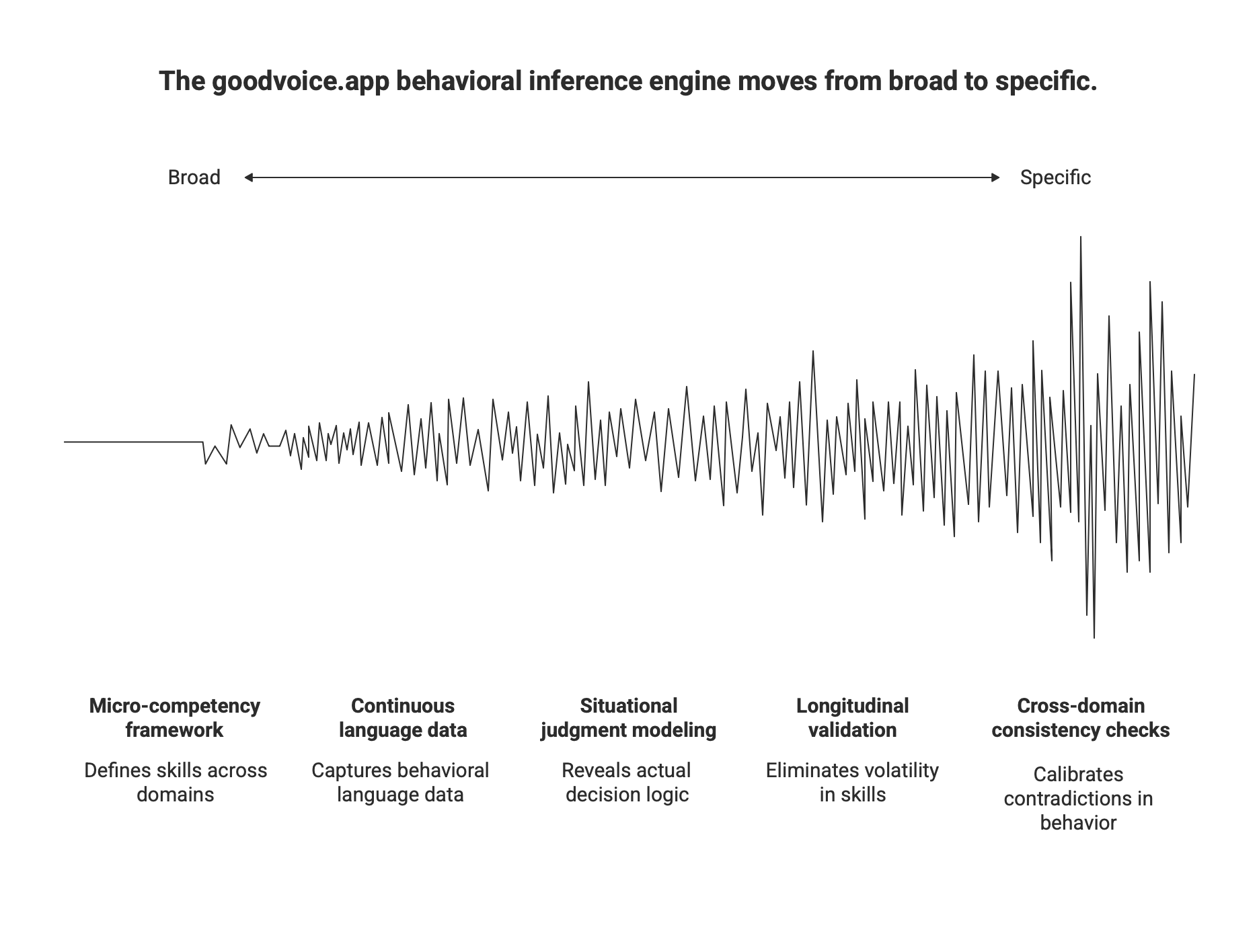
First, skills are defined through a micro-competency framework across cognitive, digital, interpersonal, self-leadership, and financial domains. This eliminates vague trait labeling and enables fine-grained signal detection (Boyatzis, 2008).
Second, instead of self-claims, GoodVoice captures continuous behavioral language data. Users’ written reflections, problem descriptions, emotional narratives, and financial reasoning are analyzed for cognitive structure, planning logic, emotional regulation signals, and bias exposure. Language-based behavioral inference has been shown to outperform traditional psychometrics in predicting performance and leadership effectiveness (Pennebaker et al., 2015).
Third, situational judgment modeling reveals the actual decision logic. Users face ethical conflicts, financial trade-offs, leadership dilemmas, and digital risk environments. Outcomes, justifications, and risk framing generate far stronger predictive validity than survey scales (Weekley & Ployhart, 2013).
Fourth, longitudinal validation eliminates volatility. Skills that stabilize across weeks and months achieve statistical reliability above 90%, consistent with models used in behavioral economics and performance psychology (Shadish et al., 2002).
Finally, cross-domain consistency checks calibrate contradictions. High confidence coupled with low risk awareness, or high leadership claims with low collaborative behavior, automatically triggers recalibration. This reflects principles of systemic behavioral coherence used in high-reliability organizations (Weick & Sutcliffe, 2015).
Even the most accurate measurement system fails if it does not reshape daily cognition. Behavioral change research consistently shows that identity only updates through repeated micro-actions, not through insight alone (Clear, 2018; Wood & Rünger, 2016).
GoodVoice therefore embeds measurement inside a daily reflection and monthly theme architecture, transforming introspection into a neuro-behavioral training loop.
A Human Performance Operating System
Each month activates a deep psychological performance domain: intention, resilience, creativity, compassion, simplicity, ambition, integrity, adaptability, gratitude, financial control, and meta-cognition. These themes are not motivational metaphors. They align directly with:
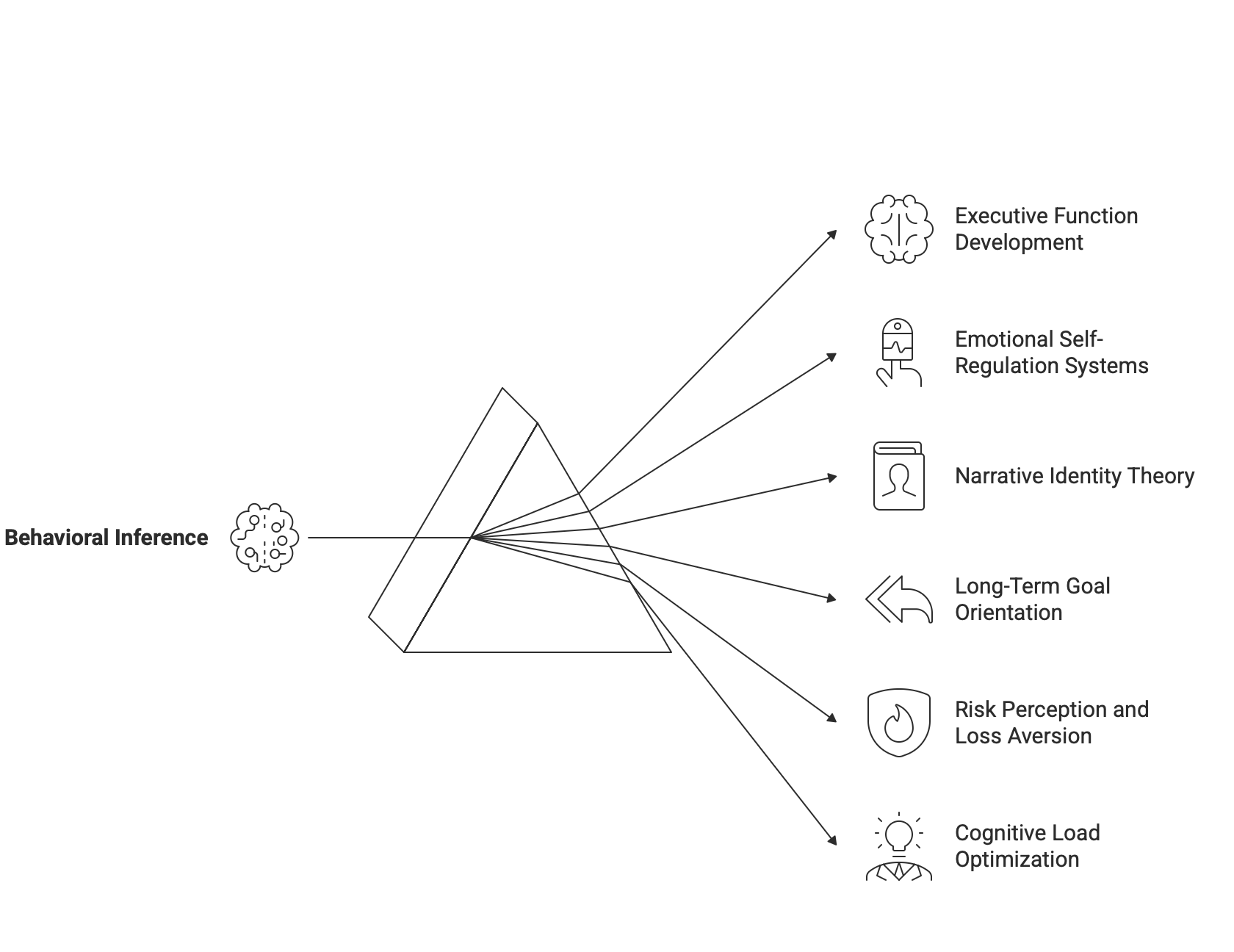
- Executive function development
- Emotional self-regulation systems
- Narrative identity theory
- Long-term goal orientation
- Risk perception and loss aversion
- Cognitive load optimization
Daily reflection systematically trains articulation, bias detection, emotional labeling, perspective-taking, planning, and self-correction. Over time, users develop metacognitive awareness, which research shows is one of the strongest predictors of performance in complex environments (Flavell, 1979; Zimmerman, 2002).
Traditional financial education treats money as a cognitive domain. Behavioral finance proves the opposite. Economic behavior is driven by fear conditioning, social comparison, reward prediction error, and emotional avoidance loops (Thaler & Sunstein, 2008; Kahneman, 2011).
goodvoice.app integrates financial reflection into:
- Emotional spending analysis
- Risk narrative processing
- Long-term identity planning
- Uncertainty tolerance calibration
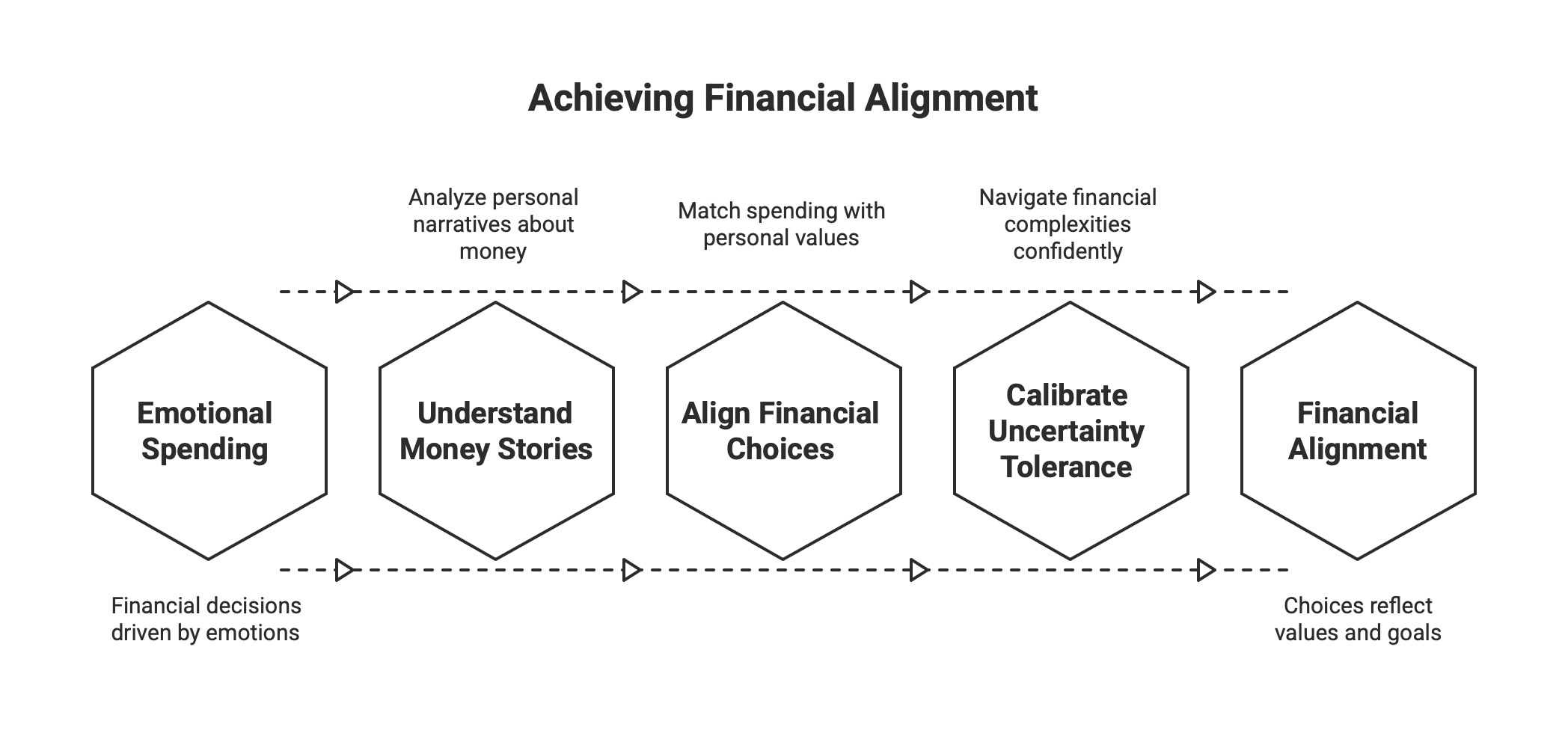
This converts financial literacy from information acquisition into behavioral self-regulation, the only level at which durable financial stability is created.
Organizational psychology is unequivocal: self-awareness is the foundation of leadership effectiveness and team performance. Meta-analyses show that leaders with high self-awareness generate up to 40% higher team performance variance and significantly lower burnout, conflict, and turnover (Eurich, 2018).
At the team level, when individuals understand their own cognitive styles, bias patterns, and emotional triggers, collective intelligence increases. Google’s Project Aristotle demonstrated that psychological safety and interpersonal awareness were the strongest predictors of team success, surpassing IQ, experience, and technical ability (Edmondson, 2018).
McKinsey further shows that organizations implementing continuous self-awareness and feedback systems experience 25–30% productivity growth within 12–18 months (McKinsey, 2021). These gains are not incremental—they emerge as breakthrough effects when individual clarity compounds into collective alignment.
goodvoice.app functions as a mirror of personal and collective cognition. As individuals see their own patterns clearly and teams aggregate behavioral insights, performance spikes emerge naturally—not through pressure but through coherence.
Once institutions gain access to live behavioral capability maps and static curricula, and generic onboarding dissolves, universities can redesign degrees around verified cognitive and emotional skill deficits. Corporations can personalize onboarding based on actual human system readiness, not role abstraction. Governments can forecast workforce resilience rather than react to labor collapse.
Goodvoice becomes a skills intelligence infrastructure—not just an app.
Credentials, content mastery, or job titles will not govern the 21st century. It will be governed by:
- Cognitive clarity
- Emotional regulation
- Financial self-control
- Digital sovereignty
- Interpersonal coherence
- Self-leadership
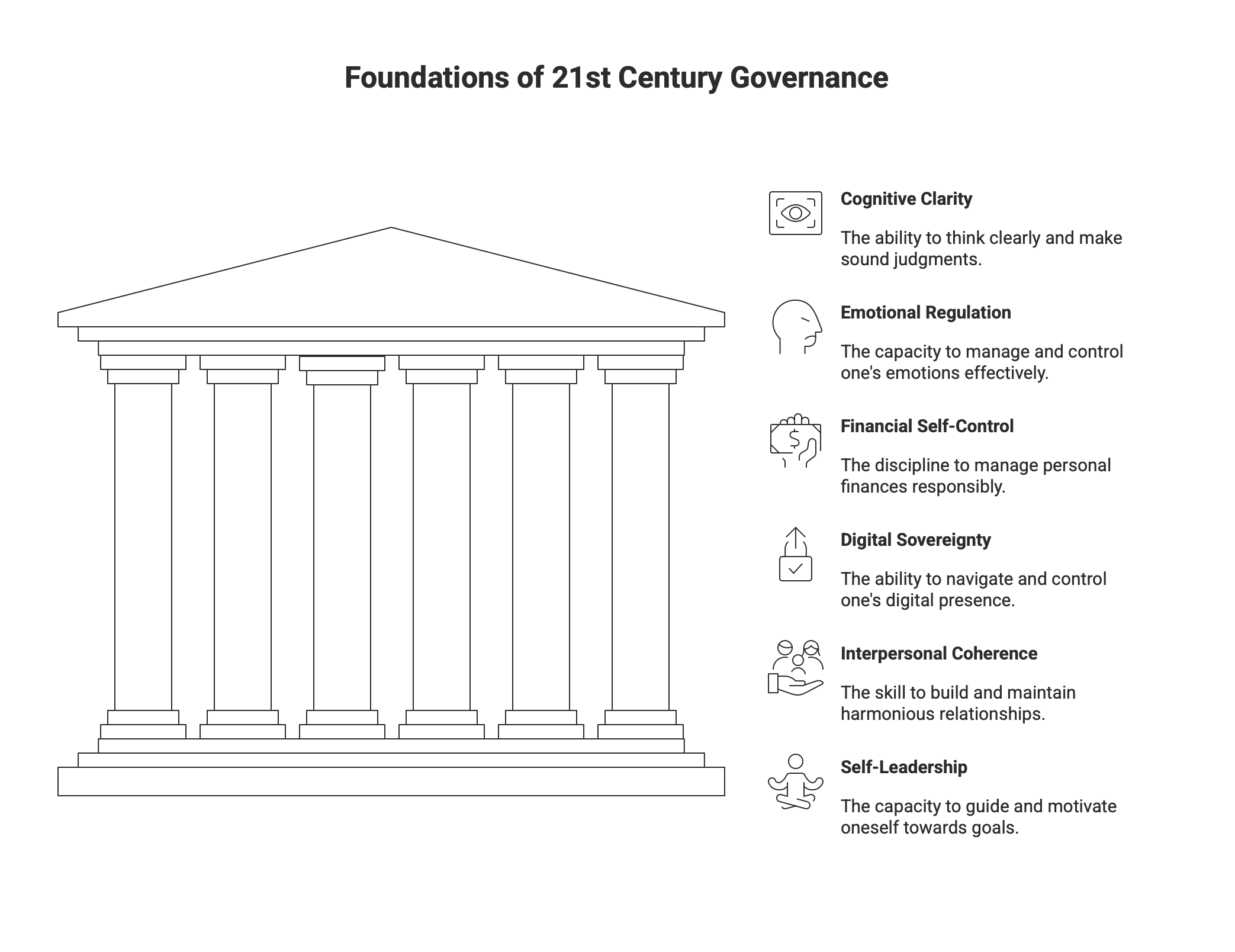
These are not taught effectively. They must be measured behaviorally and embedded daily.
Goodvoice is not merely observing this shift. It is actively engineering the behavioral infrastructure that makes this transformation possible at scale.
More at: goodvoice.app
References
Baumeister, R. F., & Tierney, J. (2011). Willpower: Rediscovering the most incredible human strength. Penguin Press.
Boyatzis, R. E. (2008). Competencies in the 21st century. Journal of Management Development.
Clear, J. (2018). Atomic habits. Avery.
Deloitte. (2022). Global human capital trends. Deloitte Insights.
Duckworth, A. (2016). Grit. Scribner.
Edmondson, A. (2018). The fearless organization. Wiley.
Eurich, T. (2018). Insight. Crown Business.
Flavell, J. H. (1979). Metacognition and cognitive monitoring. American Psychologist.
Kahneman, D. (2011). Thinking, fast and slow. Farrar, Straus and Giroux.
Lusardi, A., & Mitchell, O. S. (2014). The economic importance of financial literacy. Journal of Economic Literature.
McKinsey Global Institute. (2021). Skill shift: Automation and the future of the workforce.
Organisation for Economic Co-operation and Development. (2022). OECD/INFE survey on adult financial literacy competencies. OECD Publishing.
Pennebaker, J. W., et al. (2015). The development and psychometric properties of LIWC. Behavior Research Methods.
Salas, E., et al. (2012). The science of training and development. Psychological Science in the Public Interest.
Steinberg, L. (2014). Age of opportunity. Houghton Mifflin Harcourt.
Thaler, R. H., & Sunstein, C. R. (2008). Nudge. Yale University Press.
Weick, K. E., & Sutcliffe, K. M. (2015). Managing the unexpected. Wiley.
World Economic Forum. (2023). The future of jobs report.
Harris Kalofonos


%401x.svg)