
%402x.svg)
Before human flight became possible, inventors first had to move beyond imitation.
For centuries, people observed birds and assumed that wings were the key. Early designs copied what flight looked like, producing gliders and flapping machines that resembled birds but did not reliably work. The problem was not a lack of ambition. It was a lack of understanding of systems.
The Wright brothers approached the challenge differently.
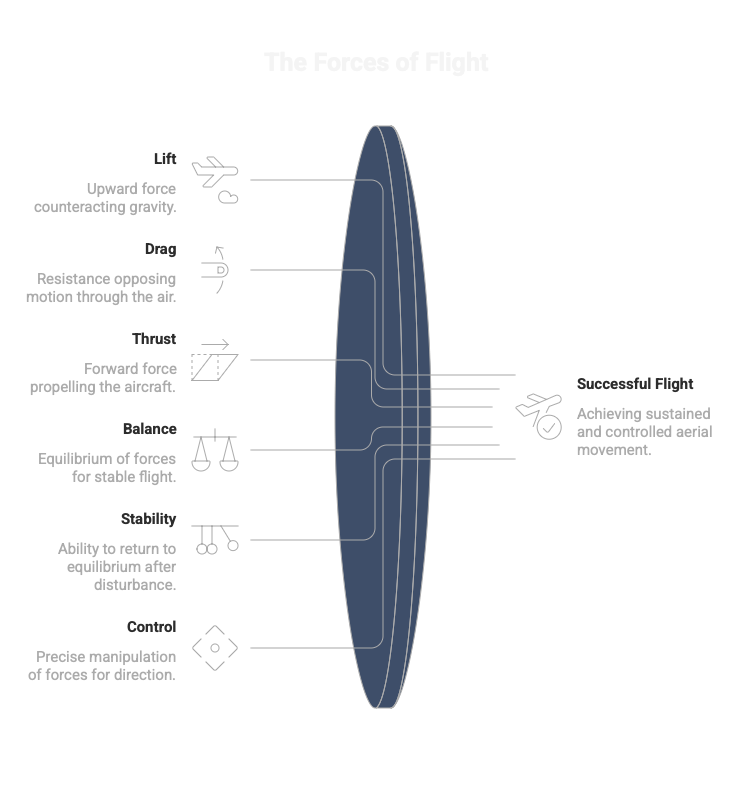
Orville and Wilbur Wright did not focus only on building a machine that appeared capable of flight. They focused on the underlying mechanics: lift, drag, balance, stability, and control. When their early gliders failed to perform as expected, they questioned the accepted data, built a wind tunnel, tested wing shapes, and developed a more accurate understanding of aerodynamics. Their breakthrough was not simply achieving flight once. It was the creation of a repeatable system that made controlled flight possible (NASA Glenn Research Center, n.d.; National Air and Space Museum, 2022).
This challenge for Olympic education closely echoes the evolution of human flight described above—revealing the importance of moving beyond surface imitation to a deeper, systemic understanding.
The modern Olympic Movement was revived with a clear educational ambition. It was not intended to promote sport alone, but to use sport, culture, and international exchange as tools for developing character, mutual respect, peaceful coexistence, and a stronger sense of shared human responsibility. In that sense, Olympic education has the potential to serve as a globally relevant, values-based educational model.
That potential is especially important today. Education systems are increasingly being asked to develop more than academic knowledge. They are expected to help young people build judgment, resilience, empathy, civic responsibility, and the ability to work across cultural differences. Olympic education already contains many of these aims within its core values of excellence, friendship, and respect.
The challenge is that Olympic education has not yet been organized at the scale or coherence required to fulfill that promise.
In many cases, it exists through valuable but disconnected initiatives: executive retreats, short-term youth programs, ceremonial academies, local projects, or corporate social responsibility and sponsorship activation efforts. These activities can create meaningful experiences, but they often operate in parallel rather than as parts of a unified educational system. They may inspire participants in the moment, but they do not always connect to a broader developmental pathway, school-based implementation, teacher preparation, assessment, or long-term learner engagement.
Olympic education must move beyond inspiring ideals and develop a foundation in proven educational principles and science.
As a result, Olympic education risks remaining fragmented. It is visible, but not fully embedded. It is respected, but not consistently scalable. It is active, but not yet structured as a coordinated global educational model capable of delivering on the original educational promise of the modern Olympic revival.
For Olympic education to expand its impact, it cannot rely only on the strength of its ideals. It needs systems that translate those ideals into educational practice. That means developing clear learning pathways, age-appropriate curricula, teacher tools, assessment approaches, digital infrastructure, and delivery models that can work across countries and contexts while remaining connected to a common philosophy.
To help leaders begin this transformation, take immediate steps such as establishing pilot programs in diverse educational settings, forming partnerships for curriculum co-design with local educators, and creating professional learning communities for teachers. Start implementing by testing modules in selected schools, collecting feedback, and expanding resources and digital supports based on what is learned. Actively document early successes and share adaptable models to build momentum for systemic change.
Olympic education must take concrete steps from programs to systems.
It is necessary to define how values become learning outcomes, how learning outcomes lead to student development, and how to align separate initiatives. Connect youth leadership camps, school-based Olympic weeks, and community projects through shared learning objectives and assessment tools, ensuring all experiences contribute to a developmental pathway. Link teachers and facilitators with regional or global educator networks, and create bridges such as joint project platforms, participant portfolios, or coordinated alumni engagement opportunities. Build a system that moves from inspiration to architecture, scattered initiatives to coordinated systems, and values proclaimed to values lived.
Act to establish the necessary architecture; without it, Olympic education will continue to produce isolated pockets of excellence. With it, the field can make a durable and scalable contribution to global education.
The Wright brothers made progress when they stopped copying the appearance of flight and began understanding the system that made flight possible.
Olympic education must now shift from symbolic expression to deliberate educational design, from isolated activity to coordinated infrastructure, and from aspiration to practical implementation. Begin by establishing structures that support these transitions.
The Olympic Revival Was Born as an Educational Reform Project
The modern Olympic Movement was not revived merely to restore an ancient sporting festival. Its revival was animated by a much larger educational concern: how to form human beings capable of character, self-discipline, civic responsibility, and international understanding.
Pierre de Coubertin, the principal architect of the modern Olympic Games, was not only a sports advocate. He was first and foremost an educational reformer. Historical accounts of his work show that he viewed sport as a vehicle for moral, civic, and intellectual development, and that his Olympic project was deeply connected to broader debates about the reform of education at the end of the nineteenth century (International Olympic Committee, n.d.; Naul, 2008).
Coubertin believed that education had become too narrow. It transmitted knowledge, but not always courage. It produced intellectual achievement, but not necessarily character. It prepared students for examinations, but not always for life, citizenship, or responsibility. He was convinced that sport, properly understood, could serve as a uniquely powerful educational medium because it demanded effort, discipline, respect for rules, acceptance of defeat, pursuit of excellence, and recognition of others.
This is why the Olympic revival was never simply about organizing international competitions. It was about creating a global educational movement through sport, culture, and encounter.
The Olympic Charter preserves this foundational educational ambition. It defines Olympism as a “philosophy of life” that blends sport with culture and education and seeks the balanced development of “body, will, and mind.” It further states that the goal of Olympism is to place sport at the service of the harmonious development of humankind and the promotion of a peaceful society that preserves human dignity (International Olympic Committee, 2024).
In other words, the Olympic Movement was built around an educational thesis:
Human beings can be formed through meaningful struggle, ethical competition, shared rules, cultural exchange, and the disciplined pursuit of excellence.
This thesis remains as urgent now as it was in Coubertin’s time. In fact,
Indeed, it may be more urgent.
The enduring promise of Olympism is not only to produce better athletes, but also better human beings.
The central insight of Olympism is that sport, when interpreted educationally, can become a school of life.
An athlete learns quickly that raw talent is insufficient. Progress requires repetition, humility, discipline, and response to feedback. Competition teaches that others are not merely obstacles; they are the very condition that calls forth one’s best effort. Rules matter. Respect matters. Self-command matters. Failure, if reflected upon, becomes formative rather than defeating.
This is why Olympic education has never been reducible to sports instruction. It seeks to transform experience into meaning.
The International Olympic Academy describes its mission as promoting Olympism as an educational philosophy and developing future generations of leaders, role models, and changemakers through learning experiences grounded in universal values (International Olympic Academy, n.d.).
That language matters. Olympic education is not only about transmitting information about the Games. It is about cultivating:
- ethical judgment,
- perseverance,
- respect for difference,
- intercultural understanding,
- responsibility,
- dignity in both victory and defeat,
- and the ability to belong to something larger than oneself.
The modern world increasingly recognizes that these are not decorative educational outcomes. They are central outcomes.
The OECD Learning Compass 2030 defines education for the future as the development of competencies that include knowledge, skills, attitudes, and values. It specifically identifies respect, fairness, personal and social responsibility, integrity, and self-awareness as essential shared values for building more inclusive, fair, and sustainable societies (OECD, 2019a, 2019b). UNESCO’s Global Citizenship Education similarly calls for learners to become ethical, empathetic, respectful human beings who can contribute to tolerance, human rights, peace, and a shared sense of global belonging (UNESCO, n.d.).
These frameworks, developed long after Coubertin, echo a core Olympic premise:Education must form the whole person.
Given this foundation, the importance of Olympic education resonates even more strongly today, as the world faces an educational and civic formation gap.
The twenty-first century has made the need for value-based education impossible to ignore.
Students are growing up in a world of unprecedented connectivity but an often weakened community. They are surrounded by information but not always equipped with judgment. They have access to platforms for expression, but not necessarily the moral preparation to use them responsibly. They are entering societies strained by polarization, misinformation, conflict, declining trust, and deep cultural fragmentation.
Education systems are being asked to do far more than prepare students for tests or employment. They are being asked to help prepare young people for life in a complex, interdependent, and fragile world.
UNESCO’s 2023 Recommendation on Education for Peace, Human Rights and Sustainable Development, adopted by its Member States, reaffirms that education must contribute to peace, human rights, international understanding, global citizenship, and sustainable development (UNESCO, 2023). The OECD has reached a similar conclusion, arguing that education plays a critical role in fostering trust among individuals and in public institutions by developing foundational skills, civic understanding, and the values necessary for democratic participation (OECD, 2025).
This is not an abstract concern. School climate, student belonging, and the quality of relationships within education are directly connected to learning outcomes. In PISA 2022, students who reported feeling safer at school, avoiding bullying, and experiencing stronger school belonging also tended to show higher life satisfaction and stronger confidence in self-directed learning. The OECD further emphasizes that teacher support, parental involvement, school safety, and regular attendance are key conditions for educational resilience (OECD, 2023).
The civic and social dimensions of education are not peripheral. They are part of the infrastructure of learning itself.
Olympic education belongs precisely in this space.
Its language of excellence, friendship, respect, peace, and human dignity is not merely ceremonial. It is a potential response to a global educational need: helping young people grow into capable, ethical, internationally minded human beings.
The Evidence Is Clear: Values-Based Education Strengthens Learning
One of the great misconceptions in education is that character, values, and social-emotional development are “soft” concerns, separate from serious academic achievement that would typically define curriculums, and policies that lead students to university and adulthood.
The evidence says otherwise.
A major 2023 meta-analysis reviewed 424 studies from 53 countries, covering 252 universal school-based social and emotional learning interventions and more than 575,000 students. The findings showed that social and emotional learning programs were associated with improvements in social-emotional skills, attitudes, prosocial behaviors, academic achievement, school climate, and school functioning (Cipriano et al., 2023).
A 2024 meta-analysis of 90 universal school-based social and emotional learning studies involving 20,626 K–12 students in the United States reached similar conclusions. Students participating in these programs showed statistically significant improvements in academic achievement, school functioning, social-emotional skills, attitudes, behavior, and perceptions of school climate and safety (Cipriano et al., 2024).
The OECD’s 2024 report, Social and Emotional Skills for Better Lives, reinforces this point at a system level. It concludes that social and emotional skills support academic learning, predict labor-market outcomes, affect health and well-being, and contribute to healthy democracies. The OECD also reports that students with stronger social and emotional skills tend to achieve better outcomes in mathematics, reading, and the arts, while showing lower rates of tardiness and school skipping. Persistence, self-control, and curiosity show particularly strong links to positive educational outcomes (OECD, 2024).
This matters profoundly for Olympic education.
The values of Olympism are not separate from the habits that support learning. Excellence requires persistence. Respect requires self-regulation. Friendship requires empathy. Fair play requires moral judgment. Peace requires the capacity to see others as human beings rather than abstractions.
An Olympic education program that intentionally develops these capacities is not moving away from educational seriousness. It is moving toward it.
Character Education Works When It Is Designed, Not Merely Declared
Value-based education becomes powerful when it is embedded in intentional pedagogy.
A 2023 meta-analysis of 214 character education studies, involving 307,512 participants, found a statistically significant positive overall effect for character education programs. The authors reported an average positive effect size of g = 0.24, with certain formats, including mentoring-based approaches, producing stronger outcomes (Brown et al., 2023).
That finding carries an important lesson:Values do not scale through slogans. They scale through designed experiences.
Students do not internalize integrity because they are told that integrity matters. They internalize it when they confront dilemmas, reflect on choices, experience accountability, and see ethical conduct modeled by adults and peers.
They do not learn respect because a poster says “respect.” They learn it when they collaborate across differences, listen carefully, compete fairly, and are asked to interpret others' humanity.
They do not learn excellence from hearing stories of champions. They learn it when they set standards, receive feedback, revise effort, endure difficulty, and understand that excellence is a long-term relationship with one’s own potential.
Olympic education already possesses a compelling moral vocabulary. The task now is to build the instructional architecture that enables those values to become measurable developmental experiences.
Sport Can Support Prosocial Development — But Only When Education Is Intentional
Olympic education is distinct from participation in sport alone. However, the evidence on sport and youth development remains important because it confirms an important premise: structured physical and collaborative experiences can support social and moral growth when guided by an educational purpose.
A 2022 systematic review of research on sports activities and prosocial behavior concluded that sports participation can improve prosocial behaviors among children and adolescents, including among young people with special educational needs. The authors emphasized that the type of sporting activity and the quality of the intervention matter, suggesting that sport is most educationally powerful when it is organized intentionally rather than assumed to be automatically beneficial (Li et al., 2022).
A 2021 systematic review and meta-analysis of sport-based positive youth development interventions likewise found that well-designed sport programs can contribute positively to developmental outcomes in young people (Bruner et al., 2021).
This distinction is crucial.
Sport does not automatically produce virtue. Competition can teach cooperation, but it can also produce arrogance. It can nurture resilience, but it can also reinforce exclusion. It can develop respect, but it can also normalize hostility if left unguided.
Olympic education matters because it provides sport with an ethical and pedagogical framework. It interprets the experience. It asks:
- What did you learn about yourself through struggle?
- How did you respond to defeat?
- Did you compete without dehumanizing your opponent?
- What does it mean to pursue excellence without losing humility?
- How does sport reveal the dignity of people from different nations, cultures, and identities?
That reflective layer is what turns sport from activity into education.
Olympic Education Aligns with the Future of Global Education
The most influential international education frameworks today are increasingly converging around a central idea: future-ready education must combine cognitive knowledge with character, agency, values, and responsibility.
The OECD Learning Compass 2030 argues that students need the capacity to use knowledge, skills, attitudes, and values in coherent and responsible ways that help shape a better future (OECD, 2019a). UNESCO’s work on Global Citizenship Education emphasizes ethical decision-making, respect for diversity, peace-building, and active contribution to just and sustainable societies (UNESCO, n.d.).
This creates an extraordinary opening for Olympic education.
Olympic education can serve as a globally intelligible, historically grounded, emotionally resonant framework for advancing many of the outcomes now prioritized by contemporary education systems:
Social-emotional learningSelf-mastery, resilience, empathyCharacter educationIntegrity, fairness, responsibilityGlobal citizenshipFriendship across cultures and nationsPeace educationHuman dignity and mutual recognitionStudent agencyExcellence through disciplined effortWell-beingBalanced development of body, will, and mindCivic formationRespect for rules, institutions, and shared life
This is not an artificial alignment. It is a rediscovery of Olympism’s original educational identity.
The Olympic Movement anticipated a truth that the wider education world is now returning to:The formation of the person is not secondary to the transmission of knowledge. It is the purpose that gives knowledge direction.
The Wright Brothers’ Lesson for Olympic Education: Understand the System Before Trying to Scale the Dream
The Wright brothers discovered that flight would not become real merely by adding larger wings or more power. It required understanding the interaction of multiple forces:
- lift,
- drag,
- thrust,
- balance,
- stability,
- control.
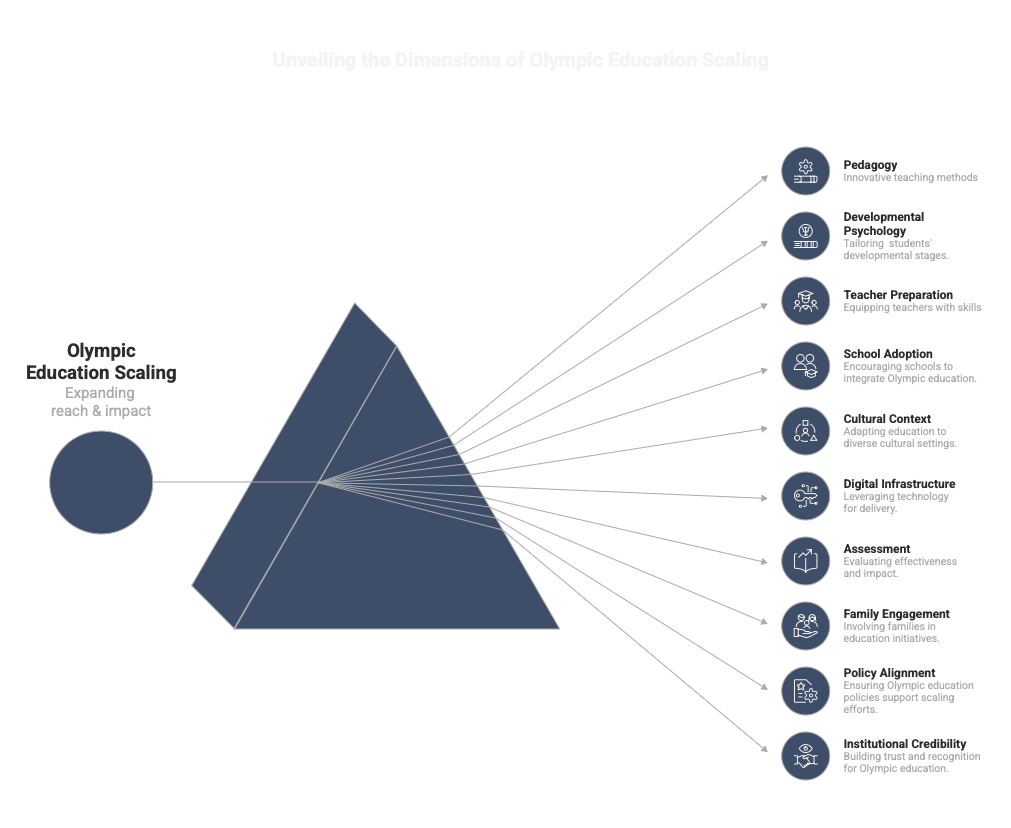
Olympic education faces a comparable challenge. Its scaling depends on understanding the interaction of multiple educational forces:
- pedagogy,
- developmental psychology,
- teacher preparation,
- school adoption,
- cultural context,
- digital infrastructure,
- assessment,
- family engagement,
- policy alignment,
- and institutional credibility.
Without that understanding, Olympic education risks remaining inspiring but episodic.
With that understanding, it can become transformative and scalable.
Educational Aerodynamics
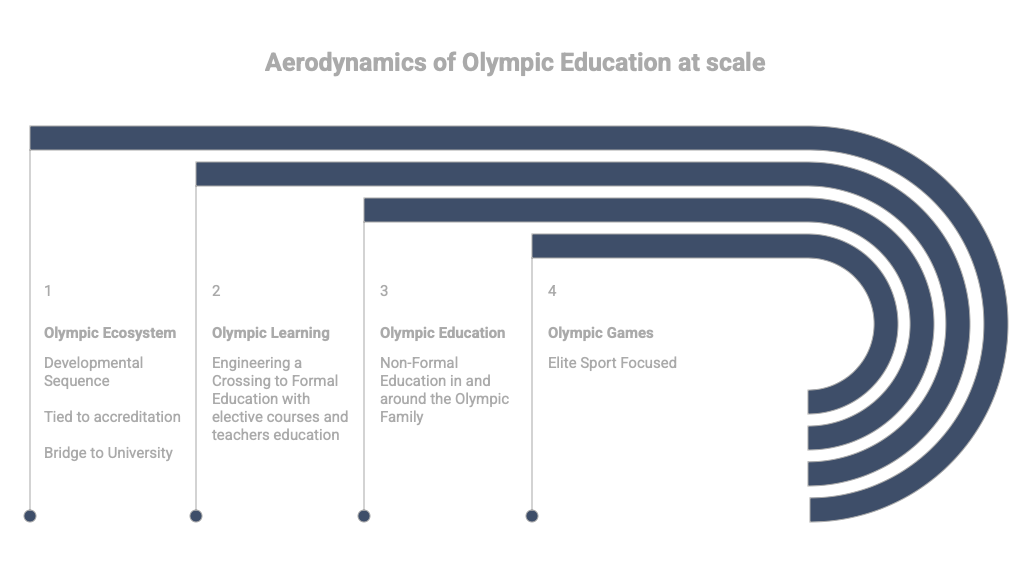
1. Developmentally Sequenced
A child in primary school, an adolescent in secondary school, a university student, and a young adult leader do not require the same educational experience.
Research in social and emotional learning and character development suggests that programs are most effective when they are developmentally appropriate, intentionally sequenced, and reinforced over time rather than delivered as isolated interventions. The breadth of positive findings across large social-emotional learning and character education reviews supports the need for structured, sustained, and age-responsive design (Brown et al., 2023; Cipriano et al., 2023; Cipriano et al., 2024).
Olympic education should therefore be built as a progression:
- Early years: fairness, effort, friendship, cooperation, respect for rules.
- Middle years: identity, self-control, resilience, teamwork, handling success and failure.
- Adolescence: leadership, global citizenship, dignity, ethical competition, media literacy, social responsibility.
- Young adulthood: peace-building, intercultural dialogue, civic leadership, international cooperation, stewardship of institutions.
This would transform Olympic education from a set of messages into a lifelong developmental pathway.
2. Experiential, Not Merely Informational
International frameworks on global citizenship and future-ready learning emphasize that values are not acquired only through instruction, but through experiences that shape judgment, agency, and behavior (OECD, 2019a; UNESCO, n.d.).
Olympic education, therefore, needs:
- collaborative challenges,
- ethical dilemmas,
- cross-cultural discussion,
- community-based projects,
- journals and reflection,
- embodied experiences,
- storytelling connected to action,
- and capstone projects that translate values into practice.
Students should not only learn what Olympism is, but also how to apply it.They should encounter situations that ask them to act Olympically.
3. Teacher-Enabled
No educational philosophy scales without the adults who enact it.
The research on school climate and student outcomes shows that teacher support, parental involvement, and safe learning environments are central to educational resilience. PISA 2022 found that stronger teacher and parent support, along with school safety and attendance, are vital conditions for healthy educational systems (OECD, 2023).
If Olympic education is to reach classrooms around the world, teachers and facilitators need:
- clear learning objectives,
- ready-to-use lesson sequences,
- discussion protocols,
- assessment rubrics,
- scenario-based case studies,
- reflection tools,
- and adaptable resources for different cultural contexts.
A curriculum that cannot be taught consistently will not scale, regardless of how beautiful its vision is.
4. Culturally Adaptable but Philosophically Coherent
The Olympic Movement is global. Education is local.UNESCO’s Global Citizenship Education framework makes clear that education for peace, dignity, and global belonging must be applicable across subjects, cultures, and social settings. The challenge is to preserve universal values while allowing for contextual interpretation (UNESCO, n.d.).
To achieve this balance, Olympic education can use practical adaptation strategies such as establishing local advisory boards to guide cultural tailoring, developing modular curricula that allow adaptation while maintaining philosophical integrity, and creating mechanisms for ongoing input from local educators and communities. These approaches help ensure that the universal values of Olympism are translated into forms that are genuinely relevant to learners across different educational realities. Olympic education needs a shared philosophical core, but it must also be able to travel:
- into public schools and private schools,into rural and urban communities,
- into digital programs and in-person academies,into regions with different histories, languages, and educational traditions.
A program that works only in one cultural setting is not yet a global educational system. It is a local success.
5. Measure Growth Without Reducing Values to Numbers
Education systems increasingly require evidence. Yet value-based education must resist the temptation to become simplistic or mechanistic. The right path is not to assign crude “respect scores” or “friendship grades,” but to develop richer forms of evidence. Research-backed tools such as the CASEL Social and Emotional Learning (SEL) Competency Rubrics, Leuven Well-being and Involvement Scales, and reflective journal templates have shown promise in supporting the nuanced assessment of both individual and group growth. Examples include:
reflective portfolios,
structured SEL rubrics,
self-assessment protocols,
peer feedback forms,observational rating scales,ethical reasoning tasks,
- project-based evidence collections,longitudinal participation records,
- Indicators of collaboration and civic engagement.
The large evidence base for social and emotional learning and character education shows that constructs such as social-emotional skills, school climate, prosocial behavior, and academic functioning can be evaluated meaningfully without flattening human development into a single test result (Brown et al., 2023; Cipriano et al., 2023; Cipriano et al., 2024).
Olympic education should contribute to this field by developing assessment models that respect the complexity of character while still providing feedback for improvement.
6. From Olympic Events to Olympic Learning Ecosystems
For decades, many youth-oriented Olympic education experiences have been powerful, but episodic. Students attend a conference, academy, or school event, feel inspired, return home, and then re-enter systems that may not carry the experience forward.
The next stage of Olympic education should be ecosystemic.
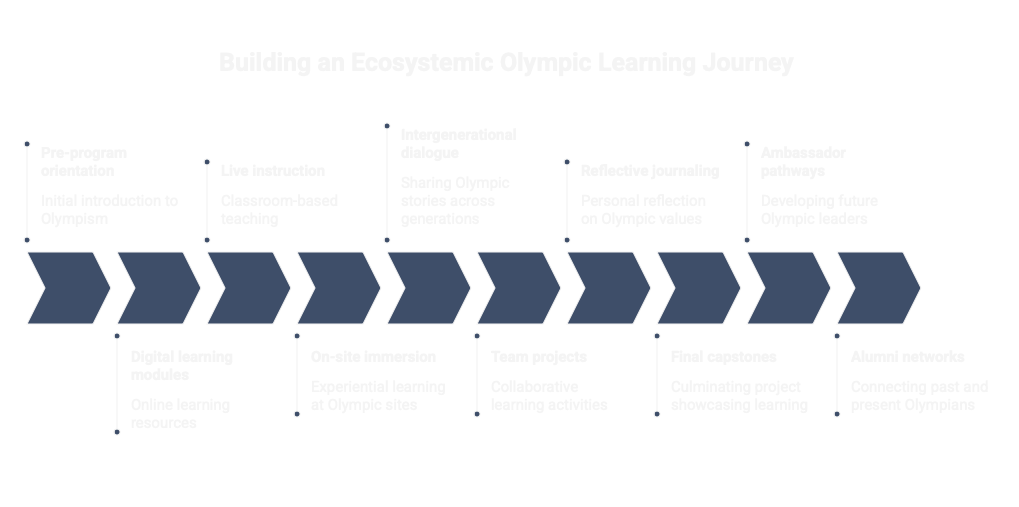
It should connect:
- pre-program orientation,
- digital learning modules,
- live instruction,
- on-site immersion,
- intergenerational dialogue,
- team projects,
- reflective journaling,
- final capstones,
- ambassador pathways,
- alumni networks,
- and long-term community engagement.
This mirrors what educational research consistently suggests: durable learning requires reinforcement, context, reflection, and transfer—not a single exposure. The positive findings from social and emotional learning, character education, and sport-based youth development research all reinforce the value of sustained, intentionally designed experiences rather than isolated moments (Bruner et al., 2021; Brown et al., 2023; Cipriano et al., 2023).
The International Olympic Academy, as the symbolic and educational heart of Olympism, has a singular opportunity to lead this transformation: to help Olympic education move from a tradition of meaningful experiences to a globally coordinated architecture of values-based learning (International Olympic Academy, n.d.). Leadership by the Academy could include convening key Olympic and educational stakeholders to define shared goals, piloting model programs in partnership with schools and youth organizations, facilitating collaborative curriculum development, launching educator training initiatives, and creating platforms for research and knowledge-sharing. By actively steering these efforts, the Academy can provide both vision and practical momentum, setting a global standard for what Olympic education can achieve.
7. The Stewards of Olympism Must Become Educational Engineers
The revivers of the Olympic Movement offered the world a promise: that sport, culture, and education together could help form better human beings and a more peaceful society.
That promise has now passed into the hands of its stewards.
Stewardship requires more than admiration. It requires responsibility. It requires the courage to ask whether Olympic education is being delivered in forms strong enough to meet the needs of this century. It requires attention not only to heritage, but to pedagogy; not only to symbols, but to systems; not only to values, but to how values become capacities in the lives of young people.
The Wright brothers did not betray the dream of flight by turning to data, wind tunnels, instruments, and engineering. They fulfilled the dream.
Likewise, Olympic education does not betray its spirit when it becomes more evidence-based, more globally adaptive, more technologically enabled, more pedagogically rigorous, and more capable of scale. It protects its spirit from becoming merely ceremonial.
It gives Olympism a lift.
8. The Goal Is Not Simply to Celebrate Olympism, but to Make It Fly
The airplane did not emerge because people loved the sky.It emerged because two brothers took the sky seriously enough to understand it.
Olympic education will not reach its full promise simply because people admire Olympic values.It will reach its promise when its stewards take education seriously enough to understand the full ecosystem through which those values must travel.
The world does not need Olympic education as a museum of noble phrases.It needs Olympic education as a living, evolving, research-informed, globally scalable force for human formation.
A force that helps young people:
- pursue excellence without arrogance,
- compete without dehumanizing,
- belong without excluding,
- lead without dominating,
- respect differences without losing conviction,
- and see peace not as an abstract ideal, but as a daily discipline of human dignity.
The Wright brothers learned the laws of flight so humanity could fly.
The stewards of the Olympic promise need to strategize to learn the laws of learning so Olympism can rise again—not only as a memory of a beautiful vision, but as a durable educational architecture for the future of the world.
References
Brown, M., McGrath, R. E., Bier, M. C., Johnson, K., & Berkowitz, M. W. (2023). A comprehensive meta-analysis of character education programs. Journal of Moral Education, 52(2), 119–138.
Bruner, M. W., McLaren, C. D., Sutcliffe, J. T., Gardner, L. A., Lubans, D. R., Smith, J. J., & Vella, S. A. (2021). The effect of sport-based interventions on positive youth development: A systematic review and meta-analysis. International Review of Sport and Exercise Psychology.
Cipriano, C., Strambler, M. J., Naples, L. H., Ha, C., Kirk, M., Wood, M., Sehgal, K., Zieher, A. K., Eveleigh, A., McCarthy, M., Funaro, M., Ponnock, A., Chow, J. C., & Durlak, J. A. (2023). The state of evidence for social and emotional learning: A contemporary meta-analysis of universal school-based SEL interventions. Child Development.
Cipriano, C., et al. (2024). A systematic review and meta-analysis of the effects of universal school-based social and emotional learning programs in the United States. Social and Emotional Learning: Research, Practice, and Policy.
International Olympic Academy. (n.d.). About the International Olympic Academy.
International Olympic Committee. (2024). Olympic Charter.
International Olympic Committee. (n.d.). Pierre de Coubertin: Visionary and founder of the modern Olympic Games.
Li, J., Shao, W., & Liu, Y. (2022). Influence of sports activities on prosocial behavior of children and adolescents: A systematic literature review. International Journal of Environmental Research and Public Health, 19(11), 6484.
NASA Glenn Research Center. (n.d.). Wright 1901 wind tunnel tests.
National Air and Space Museum. (2022). Researching the Wright way.
Naul, R. (2008). Olympic education. Meyer & Meyer Sport.
OECD. (2019a). OECD Learning Compass 2030.
OECD. (2019b). Attitudes and values for 2030.
OECD. (2023). PISA 2022 results, Volume II: Learning during—and from—disruption.
OECD. (2024). Social and emotional skills for better lives.
OECD. (2025). Building trust through education.
UNESCO. (2023). Recommendation on education for peace and human rights, international understanding, cooperation, fundamental freedoms, global citizenship, and sustainable development.
UNESCO. (n.d.). Global citizenship and peace education.
Harris Kalofonos


%401x.svg)